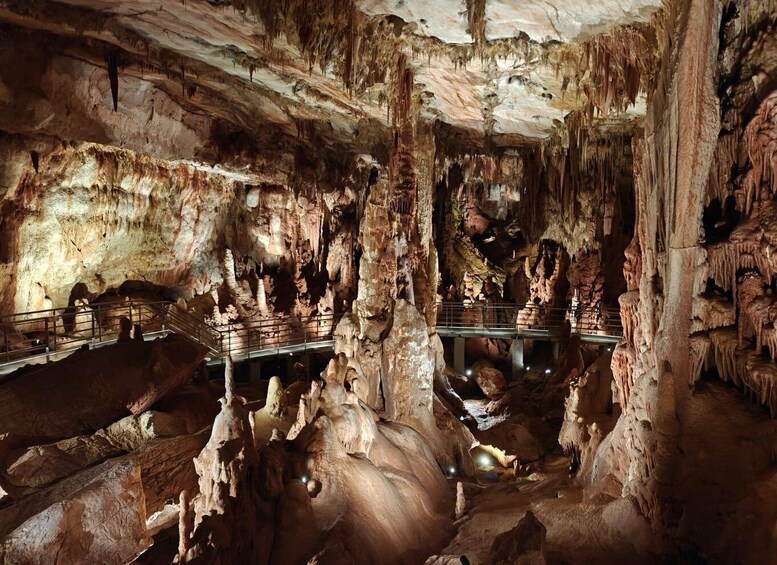
Discover the Petralona Cave, located at the foot of Mount Katsika in Halkidiki, one of Greece’s most fascinating natural and archaeological wonders. Discovered in 1959, this spectacular cave is famous not only for its breathtaking formations of stalactites and stalagmites, but also for its extraordinary prehistoric finds.
The cave became world-renowned after the discovery of the Petralona Skull, a human fossil estimated to be around 700,000 years old. This makes it one of the oldest human remains found in Europe and an invaluable piece of human history. Alongside the skull, archaeologists uncovered fossilised animal bones, tools, and evidence of the earliest controlled use of fire in Europe.
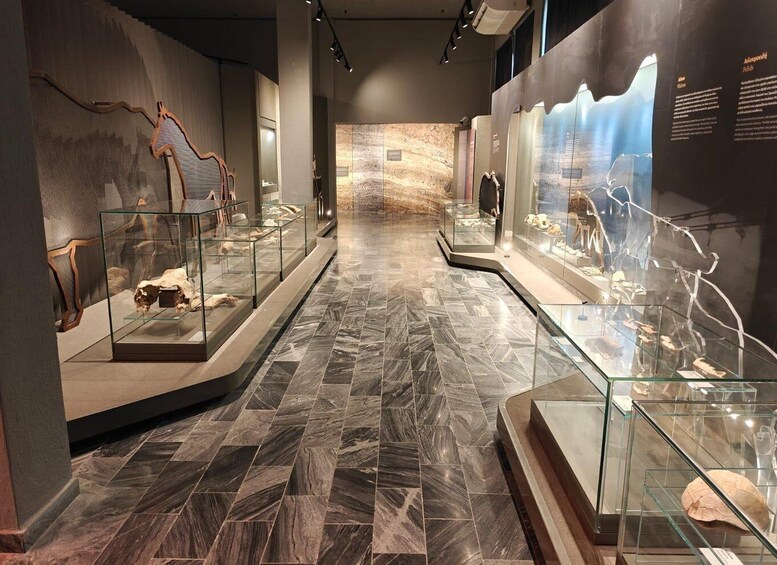
Explore the cave's awe-inspiring chambers, walk among shimmering rock formations, and step into a timeline that stretches back hundreds of thousands of years. Nearby, the Anthropological Museum of Petralona displays the remarkable discoveries, offering deeper insight into the cave’s significance in the storey of human evolution.
Then, visit the Byzantine Museum of Chalkidiki, located in a historic monastic complex in Nea Flogita. Part of the Centre for Byzantine Culture “Justinianus,” the museum presents Early Christian and Byzantine antiquities in two main halls. A highlight is the open conservation workshop, where you can watch restorers working on books, icons, and ceramics.
There will finally be a visit to Nea Moudania, where participants can explore the great port village.