


Earn OneKeyCash when you sign in and book an activity
Kanchipuram and Mahabalipuram Tour with Lunch
By Wish Tours
Free cancellation available
includes taxes & fees
per adult*
*Get a lower price by selecting multiple travellers
Features
- Free cancellation available
- 12h
- Mobile voucher
- Instant confirmation
- Selective hotel pickup
- Multiple languages
Overview
Discover the rich heritage of Kanchipuram and Mahabalipuram on this full-day private tour from Chennai. Visit the iconic temples of Kanchipuram, known as the 'City of a Thousand Temples,' and explore the ancient rock-cut architecture of Mahabalipuram, a UNESCO World Heritage Site. Enjoy a guided experience that includes entrance tickets and a delicious lunch, ensuring a comprehensive exploration of these cultural treasures.
- Full-day private tour from Chennai to Kanchipuram and Mahabalipuram
- Visit renowned temples and UNESCO World Heritage Sites with a knowledgeable guide
- Includes entrance tickets for all attractions and a tasty lunch
- Convenient transport in a private car for a comfortable experience
Activity location
- Varadharaja Perumal Temple
- W Nethaji Nagar Mada St
- 631501, Kanchipuram, India
Meeting/Redemption Point
- Varadharaja Perumal Temple
- W Nethaji Nagar Mada St
- 631501, Kanchipuram, India
Check availability
Tour with Guide and Tickets
- 12h
- English
Lunch
Private Vehicle
Pickup included
Language options: English
Price details
S$121.81 x 2 AdultsS$243.62
Total
includes taxes & fees
*Get lower prices by selecting more than 2 adults
Live French Tour with Tickets
- 12h
- English
Lunch
Private Vehicle
Pickup included
Price details
S$177.92 x 2 AdultsS$355.84
Total
includes taxes & fees
*Get lower prices by selecting more than 2 adults
What's included, what's not
- Private transport
- Bottled water
- Entrance fee
- Lunch
- Air-conditioned vehicle
- Service charge
- Personal Expenses
- Things Which are not mentioned ininclusions
Know before you book
- Public transport options are available nearby
- Infants are required to sit on an adult’s lap
- Suitable for all physical fitness levels
Activity itinerary
Varadharaja Perumal Temple
- 40m
- Admission ticket included
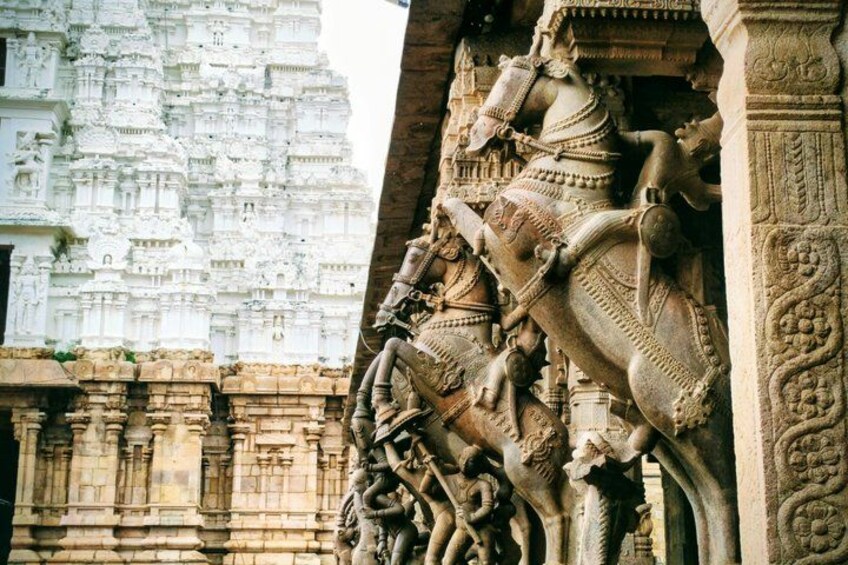
Visit one of the most sacred Vishnu temples in South India, perched atop Hastagiri Hill in the heart of Kanchipuram. Dedicated to Lord Vishnu as Varadharaja (“King who grants boons”) and his consort Perundevi Thayar, this ancient shrine is counted among the 108 Divya Desams revered by the Alvar saints and is often ranked alongside Srirangam and Tirupati as one of the three holiest Vaishnavite sites.
Originally built by the Pallavas and significantly expanded by the Cholas (11th century) and later the Vijayanagara kings, the sprawling complex showcases classic Dravidian architecture with towering gopurams, multiple prakarams (enclosures), and a celebrated 100-pillared hall filled with sculpted yalis, warriors, and scenes from the Ramayana and Mahabharata. The temple is also famous for the rare Athi Varadar idol, displayed only once every 40 years, and its gold-covered vimana over the sanctum
Ekambareswarar Temple
- 40m
- Admission ticket included
Step into Kanchipuram’s largest and most iconic Shiva temple, one of the Pancha Bhoota Stalams representing the element Earth (Prithvi). Dedicated to Lord Shiva as Ekambareswarar and Goddess Kamakshi (Parvati), this sprawling 23–25 acre complex traces its origins to around 600 CE, with major expansions by the Pallavas, Cholas, and especially the Vijayanagara empire.
The temple is dominated by its colossal Raja Gopuram, an 11-storey southern tower rising about 57–59 m (187–194 ft), commissioned by Krishnadevaraya in 1509 and among the tallest in South India. Inside, visitors encounter five concentric courtyards, a celebrated 1000-pillared hall, multiple shrines, and a unique Sahasra Lingam (a single lingam carved with 1,008 smaller lingams), all set within a deeply atmospheric, living temple complex.
Kailasanatha Temple
- 40m
- Admission ticket included
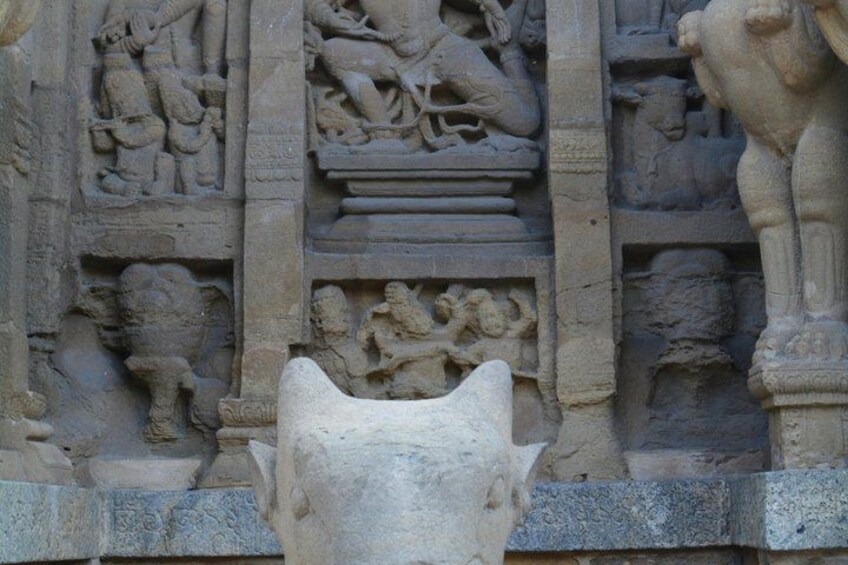
Step into Kanchipuram’s oldest surviving structural temple, a masterpiece of mature Pallava architecture dedicated to Lord Shiva as Kailasanathar, “Lord of Mount Kailasa.” Commissioned around 700–728 CE by King Narasimhavarman II (Rajasimha) and completed by his son Mahendravarman III, this sandstone temple is often called the “Sand Temple” for its exquisite carvings and refined Dravida style.
The complex is organised around a square sanctum with a sixteen-faceted Shiva lingam, surrounded by a circumambulatory passage and a ring of 58 miniature shrines set into the enclosure wall—each originally housing a different form of Shiva and his retinue. The outer walls and cells are covered with sculptural panels showing Shiva as Somaskanda (with Uma and Skanda), Lingodbhava, Tripurantaka, Urdhva-tandava, and in various dance poses, making it one of the most richly decorated Pallava temples in Tamil Nadu.
Pancha Rathas
- 30m
- Admission ticket included
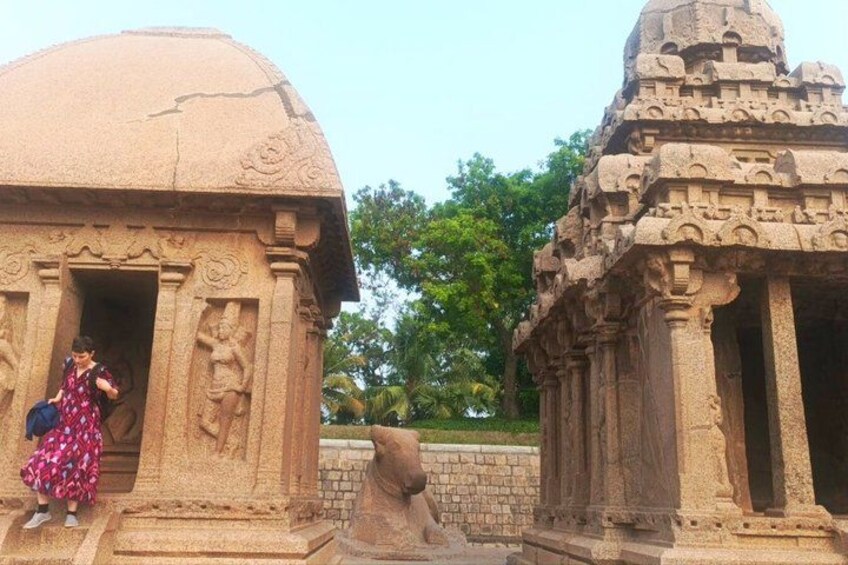
Step back into the 7th-century Pallava era at Pancha Rathas, a UNESCO World Heritage site on the Coromandel Coast. Carved from a single granite outcrop, these five monolithic “chariot” temples—named after the Pandavas (Dharmaraja, Bhima, Arjuna, Nakula, Sahadeva) and Draupadi—showcase early Dravidian architecture in miniature form.
Each ratha features a distinct roof style and sculptural details, from the pyramidal Dharmaraja Ratha to the barrel-vaulted Bhima Ratha and the hut-like Draupadi Ratha.
Though never completed, the complex remains one of Mahabalipuram’s most photographed monuments and a perfect stop on heritage walks near the Shore Temple and Arjuna’s Penance.
Krishna Mandapam
- 15m
- Admission ticket included
tep into a 7th-century rock-cut cave where Pallava sculptors brought Krishna’s legends to life in stone. Originally an open-air bas-relief, this monument was later enclosed by a pillared mandapa in the 16th century, protecting its exquisite carvings.
The highlight is the celebrated panel of Krishna lifting Govardhana Hill on his finger to shelter villagers, cowherds, and cattle from Indra’s deluge—a scene often called one of the most poetic depictions of this myth in Indian art. Surrounding panels show pastoral life, milkmaids (gopis), and Krishna’s playful interactions, blending devotion with everyday village scenes. Located right next to Arjuna’s Penance, it’s an essential stop on any Mahabalipuram heritage walk.
Arjuna's Penance
- 20m
- Admission ticket included
Stand before the world’s largest open-air bas-relief at Arjuna’s Penance, a 7th-century masterpiece carved on two massive granite boulders. Measuring about 96 feet long and 43 feet high, this UNESCO-listed monument depicts two intertwined Hindu legends: Arjuna’s intense penance to Lord Shiva for a divine weapon, and King Bhagiratha’s devotion that brought the sacred Ganges down to earth.
The rock face comes alive with over 150 finely carved figures—gods, sages, hunters, animals, and celestial beings—frozen in a moment of mythical drama. A natural cleft in the rock is ingeniously used to represent the flowing Ganges, with serpents and spirits ascending along its path. Located just steps from the Shore Temple and Five Rathas, it’s a highlight of any Mahabalipuram heritage walk.
Krishna's Butter Ball
- 15m
- Admission ticket included
Marvel at one of India’s most photographed natural wonders: a 250-ton granite boulder that has defied gravity for over 1,200 years. Perched precariously on a 45-degree slope, this massive “balancing rock” measures about 6 metres high and 5 metres wide, yet has never budged—even through earthquakes, cyclones, and repeated attempts to move it.
Locally known as Vaan Irai Kal (“Stone of the Sky God”), the boulder earned its popular name from the legend that it resembles a giant dollop of butter dropped by the child-god Krishna. Part of the UNESCO-listed Group of Monuments at Mahabalipuram, it’s a fun, family-friendly stop with great photo opportunities and a touch of mythical charm.
Varaha Cave Temple
- 10m
- Admission ticket included
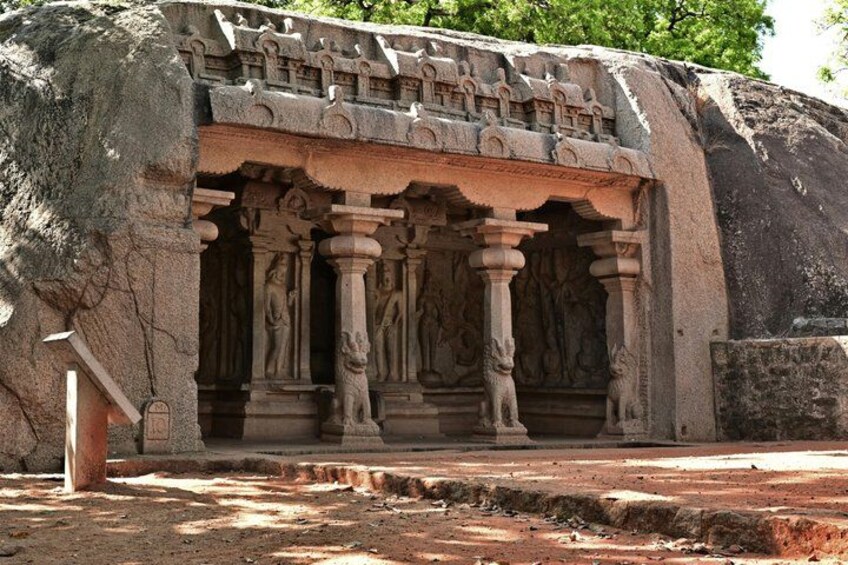
Step into a 7th-century rock-cut sanctuary dedicated to Lord Vishnu’s boar incarnation, Varaha, who rescued the Earth from the cosmic ocean. Part of the UNESCO-listed Group of Monuments at Mahabalipuram, this Pallava-era cave temple is celebrated for its exquisite central relief of Varaha lifting Bhudevi (Mother Earth)—a masterpiece of naturalistic sculpture and devotional storytelling.
The cave’s interior walls feature four major panels: the towering Varaha panel (with the demon Hiranyaksha underfoot), Gajalakshmi (Lakshmi bathed by elephants), Trivikrama (Vishnu as Vamana spanning the cosmos), and Durga with her attendants. Supported by lion-pillars and pilasters, the mandapa blends serene architecture with vivid mythical scenes, making it one of Mahabalipuram’s most refined cave temples.
Dharmaraja Ratha
- 10m
- Admission ticket included
Explore one of Mahabalipuram’s earliest and most elegant rock-cut cave temples, the Dharmaraja Mandapam, also known as the Atyantakama Cave Temple. Carved into the southern slope of Mamallapuram hill near the Mahishamardini Cave, this 7th-century Pallava monument showcases a simple yet refined design typical of the early cave-temple phase.
The mandapam features a pillared façade, a front hall (mukha-mandapa), and an inner chamber (ardha-mandapa) leading to three cells along the rear wall—likely dedicated to Shiva, Brahma, and Vishnu in a classic Trimurti layout. Though some sculptures and guardian figures (dvarapalas) were damaged over time, the cave still retains its serene atmosphere and an important 14-line Sanskrit inscription in Grantha script that links the shrine to King Atyantakama (a Pallava royal title).
Raya Gopura
- 10m
- Admission ticket included
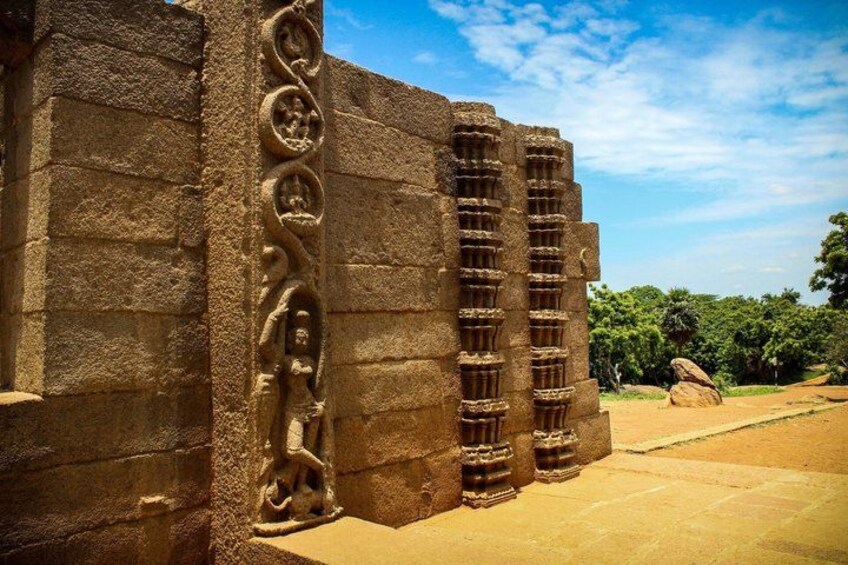
Stand before the haunting beauty of Raya Gopuram, an unfinished temple gateway that hints at the grandeur it was meant to become. Part of the UNESCO-listed Group of Monuments at Mahabalipuram, this 16th-century Vijayanagara structure was likely intended as a monumental entrance to the hilltop shrines, but construction was halted before the towering gopuram could rise.
Despite its incomplete state, the site impresses with two central pillars adorned with elegant sculptures: graceful female figures atop mythical yali mounts, and upper panels depicting the Dasavatara—the ten avatars of Vishnu. Its quiet, less-crowded setting near Ganesh Ratha makes it a perfect stop for photography and a glimpse into the ambitions of Vijayanagara-era builders.
Mahishasuramardini Cave
- 15m
- Admission ticket included
Step into a 7th-century rock-cut sanctuary where the goddess Durga’s epic battle against the buffalo demon Mahishasura is frozen in stone. Part of the UNESCO-listed Group of Monuments at Mahabalipuram, this Pallava-era cave temple is celebrated for its dynamic bas-relief panel of Mahishasuramardini—the “crusher of Mahishasura”—considered one of the finest depictions of this myth in South Indian art.
The cave features three main sanctum panels: Vishnu reclining on Adishesha (Ananthashayani), Durga slaying Mahishasura as the central deity, and Shiva with Parvati and Skanda (Somaskhanda). The Durga panel, about 4 metres long and 2.5 metres high, shows the goddess mounted on a prancing lion, bow drawn, in a moment of fierce, graceful combat. Perched on a hillside near Dharmaraja Mandapam, it’s a quieter but artistically rich stop on any Mahabalipuram heritage walk.
Shore Temple
- 40m
- Admission ticket included
Stand before one of South India’s earliest and most iconic stone temples, rising dramatically against the Bay of Bengal. Built in the early 8th century under the Pallava king Narasimhavarman II (Rajasimha), the Shore Temple marks a key shift from rock-cut caves and monolithic rathas to free-standing structural temples that would define Dravidian architecture for centuries.
The complex houses three shrines: two dedicated to Shiva (one east-facing with a linga, one west-facing with a Somaskanda panel of Shiva, Parvati, and Skanda) and a smaller central shrine to a reclining Vishnu (Anantashayana) carved from the bedrock. Constructed from finely dressed granite blocks, its twin pyramidal vimanas, sculpted parapets, and Nandi bulls make it the visual symbol of Mahabalipuram and a UNESCO World Heritage site.
Location
Activity location
- Varadharaja Perumal Temple
- W Nethaji Nagar Mada St
- 631501, Kanchipuram, India
Meeting/Redemption Point
- Varadharaja Perumal Temple
- W Nethaji Nagar Mada St
- 631501, Kanchipuram, India
Best Deals on Things to Do
Experience the wonders of the world up close with great deals on things to do near and far. Expedia offers one-of-a-kind activities that allow you to explore Kanchipuram your way. Whether you love nature, culture, food or a bit of adventure, we have the perfect activity for you.
Top experiences in Kanchipuram
With so many things to do in Kanchipuram, planning the perfect day out may seem like a daunting task. Expedia is here to take the hassle out of finding the best attractions, tours and activities in Kanchipuram. Families, couples and business travellers can all find the perfect activity in Kanchipuram to create life-long memories with the help of Expedia.