
expedia
One Key

Earn OneKeyCash when you sign in and book an activity
Oslo Walking Tour with Audio Guide on your Smartphone

By TouringBee
Free cancellation available
Price is S$10 per adult

Features

  • Free cancellation available
  • 3h
  • Mobile voucher
  • Instant confirmation
  • Multiple languages

Overview

The audio guide serves as a handy mobile companion for a self-guided tour of Oslo. This tour is specifically designed for those looking to explore the city in a short span of 2-3 hours. Simply follow the route on the app's map, which takes you from the central station to the beach, passing through the city center's attractions. You're guaranteed to see: The Cathedral, The Opera House, The Parliament, The Town Hall, The Royal Palace, The Akershus Fortress, The Munch Museum, The Nobel Peace Centre, The picturesque landscapes of Oslo Fjord.

Once you've downloaded the tour, the app operates offline. The audio guide can always be heard clearly through your headphones. Enjoy captivating stories and legends at your own pace, without the need to keep up with a tour group.
If you only have a few hours to spare in Oslo, spend it with the audio guide and you won't miss a thing.

Activity location

  • Tiger Sculpture
    • Jernbanetorget 1
    • 0154, Oslo, Norway

Meeting/Redemption Point

  • The Tiger
    • Jernbanetorget
    • 0154, Oslo, Oslo, Norway

Check availability


English in English
  • Activity duration is 3 hours3h
    3h
  • Opening hours: Sat 7:00-20:00
  • English
Language options: English
Price details
S$10.30 x 1 AdultS$10.30

Total
Price is S$10.30
German in German
  • Activity duration is 3 hours3h
    3h
  • Opening hours: Sat 7:00-20:00
  • German
Language options: German
Price details
S$10.30 x 1 AdultS$10.30

Total
Price is S$10.30
Polish in Polish
  • Activity duration is 3 hours3h
    3h
  • Opening hours: Sat 7:00-20:00
  • Polish
Language options: Polish
Price details
S$10.30 x 1 AdultS$10.30

Total
Price is S$10.30

What's included, what's not

  • What's includedWhat's included
    Landmark Illustrations
  • What's includedWhat's included
    One-year access to the tour in your preferred language
  • What's includedWhat's included
    Audio guide app for iPhone and Android
  • What's includedWhat's included
    Offline map featuring a route for effortless GPS navigation
  • What's includedWhat's included
    25 audio recordings narrated by a professional historian
  • What's excludedWhat's excluded
    In-person tour guide
  • What's excludedWhat's excluded
    Smartphone and Headphones
  • What's excludedWhat's excluded
    Transport
  • What's excludedWhat's excluded
    Food and Drinks

Know before you book

  • Public transport options are available nearby
  • Suitable for all physical fitness levels
  • The audio guide is available through a mobile app for iOS and Android
  • Entry tickets to the museums are not included and must be purchased separately in advance
  • The tour does not cover all sights in Oslo
  • This is a self-guided tour, you will need to download the audio guide mobile app, activate your purchase, and follow the route on the app's map without a human guide
  • The audio guide can be accessed at any time. The date and time provided during checkout are merely estimates

Activity itinerary

Tiger Sculpture

  • 10m
The Tiger at Jernbanetorget in Oslo is more than just a sculpture — it’s a symbol of the city’s raw energy. Gifted by Eiendomsspar in 2000 to mark Oslo’s 1000th anniversary, the bronze tiger lounges confidently in front of Oslo Central Station, welcoming travellers with a playful snarl. The nickname "Tigerstaden" (Tiger City), coined by poet Bjørnstjerne Bjørnson, once implied the city’s dangers — now it suggests vitality and edge. Locals love it, tourists climb it, and it purrs at the heart of the capital’s chaos.

Barcode Oslo

  • 10m
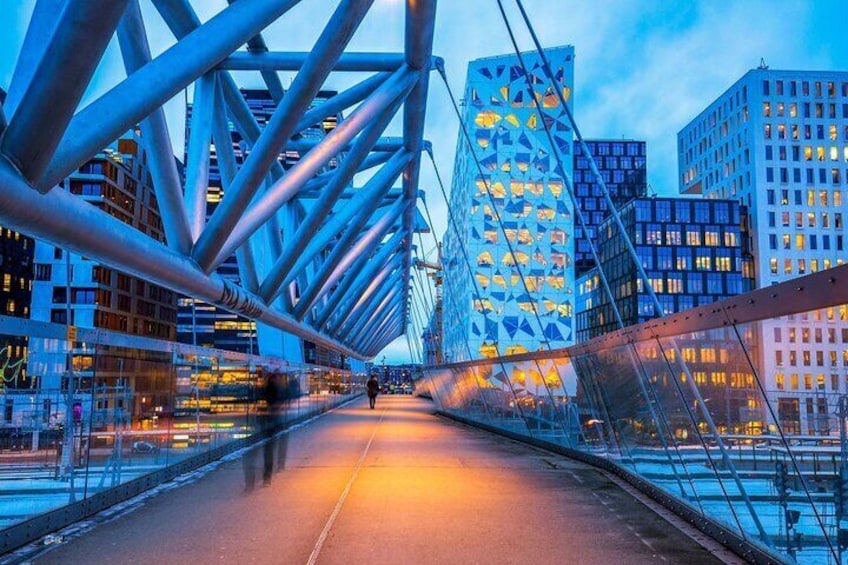
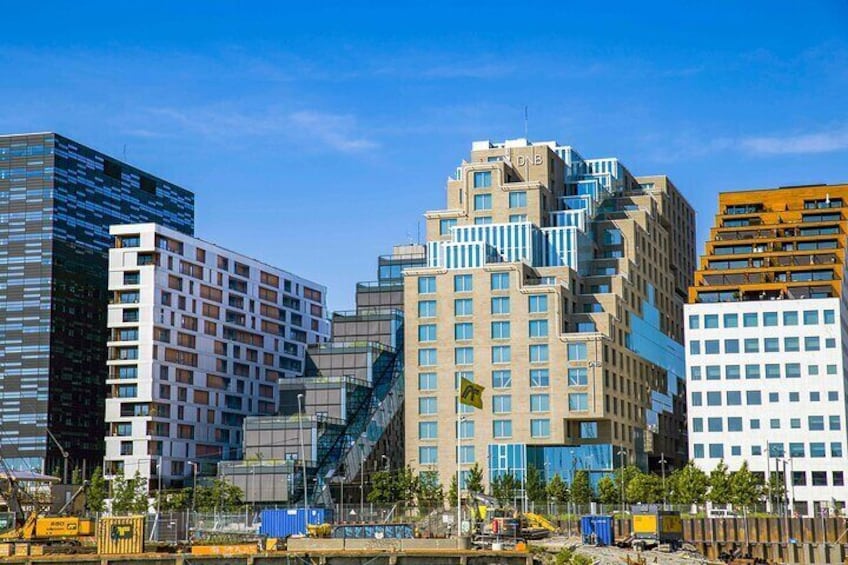
Barcode Quarter in Oslo is a striking row of modern high-rises along the Bjørvika waterfront, resembling the lines of a barcode when viewed from a distance. Designed by multiple international architects, this controversial and eye-catching project redefined Oslo’s skyline starting in the 2000s. Housing offices, apartments, restaurants, and galleries, it’s a sleek contrast to the historic city centre. Love it or hate it, Barcode symbolises Oslo’s leap into bold urban modernism — glass, steel, and ambition packed into vertical rhythm.

Munch (Pass by)

The Munch Museum (MUNCH) in Oslo is a soaring tribute to Norway’s most iconic artist, Edvard Munch. Opened in 2021 in a dramatic waterfront tower in Bjørvika, the museum houses over 26,000 works donated by Munch himself, including versions of The Scream, Madonna, and The Dance of Life. More than a gallery, it’s an emotional landscape — raw, immersive, and deeply human. The building’s tilted silhouette reflects both architectural boldness and Munch’s turbulent inner world. It’s not just a museum — it’s a confrontation with the soul.

Oslo Opera House (Pass by)

The Oslo Opera House rises like an angular glacier from the waters of the Oslofjord, inviting you to walk its sloping white marble roof and gaze over the city. Designed by Snøhetta and opened in 2008, it's a triumph of modern Scandinavian architecture—clean lines, natural light, and public space blending seamlessly. Inside, oak and glass embrace performances from opera to ballet. But even without a ticket, the building itself performs: minimalist, monumental, and open to all, it’s where art, architecture, and landscape quietly converge.

Gamle Logen - Banqueting Oslo

  • 10m
Gamle Logen — “The Old Lodge” — is one of Oslo’s most elegant historical venues, built in 1836 as a Masonic hall and later transformed into a centre for music and culture. With its Neoclassical façade and richly decorated concert hall, it has hosted everyone from Edvard Grieg to state dignitaries. Tucked behind the Parliament, it’s a quieter gem — less flashy than the Opera House, but steeped in legacy. Today, it still echoes with chamber music, literary salons, and candlelit soirées — a refined corner of the city where the 19th century lingers gracefully.

Max Manus

  • 10m
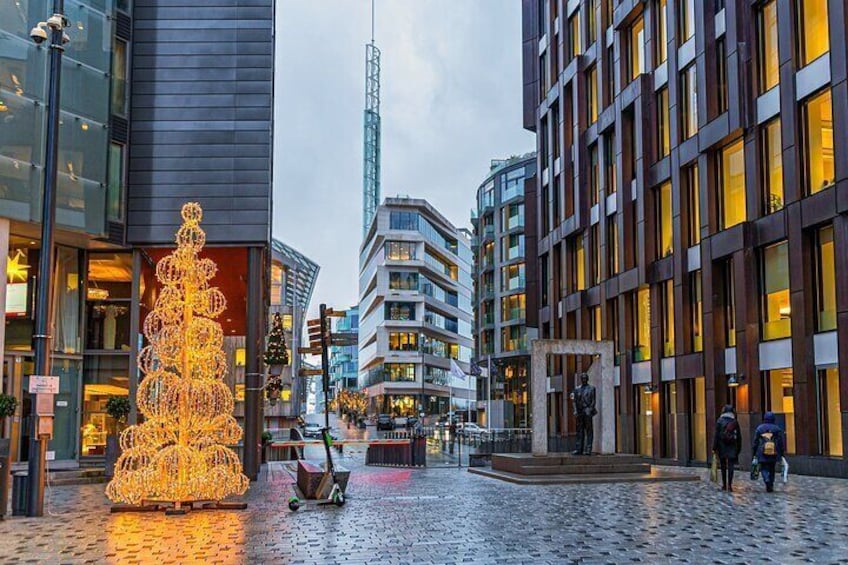
The Max Manus statue stands quietly near Akershus Fortress in Oslo, honouring the famed WWII resistance fighter. Unveiled in 2011, the bronze figure captures Manus in mid-stride — coat flaring, expression focused, as if still on a mission. He’s not posed as a triumphant warrior but as a determined man in motion, embodying the restless courage that defined his fight against Nazi occupation. Set against the backdrop of the harbour he once helped sabotage, the statue is a sober tribute: not just to a hero, but to the risks he carried with every step.

Akershus Fortress

  • 10m
Akershus Fortress looms over Oslo’s harbour, a medieval stronghold turned royal residence, prison, and military base. Built in the late 13th century, it withstood sieges, housed monarchs, and later became a grim Nazi prison during World War II. Its stone halls echo with power and resistance—here, traitors were judged, and heroes like Max Manus planned sabotage. Today, it’s a peaceful site with panoramic views, museums, and ghost stories lingering in the vaults. More than a fortress, it’s Oslo’s stone memory — weathered, layered, and very much alive.

Norges Hjemmefrontmuseum

  • 10m
The Norges Hjemmefrontmuseum (Norwegian Resistance Museum) lies within the stone walls of Akershus Fortress, quietly telling one of Norway’s fiercest stories. Through original artefacts, documents, and photographs, it traces the clandestine struggle against Nazi occupation from 1940 to 1945—sabotage missions, underground presses, coded messages, and quiet bravery in everyday acts. Dimly lit and immersive, the museum doesn’t shout; it whispers stories of courage, loss, and survival. It’s not just history — it’s testimony, sealed in concrete and conviction.

Christian IV's Glove

  • 10m
Christian IV's Glove is a curious and somewhat mysterious relic embedded in the stone wall at Akershus Fortress. According to legend, Denmark-Norway’s flamboyant King Christian IV dropped his glove here during a visit in the 17th century—and, in royal fashion, ordered it left as a symbol of his power and presence. Today, the metal sculpture of a glove remains fixed in the wall, easily overlooked by passersby. It’s a small, almost whimsical echo of monarchical ego — a king’s forgotten gesture turned into a permanent footnote in stone.

Nordisk Bibelmuseum (Pass by)

The Nordic Bible Museum (Nordisk Bibelmuseum) in Oslo is a niche treasure for book lovers and history buffs alike. Opened in 2018, it houses over 5,000 Bibles in more than 1,500 languages — including a page from a Gutenberg Bible and early Scandinavian translations. It’s not just about scripture, but printing, language, and the way texts shaped cultures. Exhibits include illuminated manuscripts, tiny pocket Bibles, and even Bible comics. Quiet and deeply curated, it’s a small museum with a weighty subject: how a single book reshaped the world, word by word.

The Mini Bottle Gallery (Pass by)

The Mini Bottle Gallery in Oslo is delightfully absurd — a museum dedicated entirely to miniature bottles. Founded by collector Christian Ringnes, it houses over 53,000 tiny bottles, from vintage liquor miniatures to bizarre novelties shaped like animals, skulls, or body parts. Some are historic, others hilarious, and a few are downright surreal. Spread across multiple quirky rooms, it’s part bar, part curiosity cabinet, and part fever dream. If you like your culture weird, distilled, and served with a wink — this one’s for you.

Oslo Cathedral (Oslo Domkirke)

  • 10m
Oslo Cathedral (Oslo Domkirke), consecrated in 1697, is a blend of Baroque grandeur and Scandinavian restraint. Tucked in the city centre, it’s seen coronations, royal weddings, and silent vigils. The interior stuns with vivid ceiling frescoes, a bold altarpiece, and 20th-century stained glass by Emanuel Vigeland. Outside, the square hosts markets and protests alike — faith and civic life in constant dialogue. The cathedral isn’t just a sanctuary; it’s a working heart of Oslo, ringing with history, ceremony, and the quiet hum of everyday reverence.

Karl Johans gate

  • 10m
Karl Johans gate is Oslo’s main artery — a lively boulevard stretching from Oslo Central Station to the Royal Palace. Named after King Karl Johan of Sweden-Norway, it blends grand institutions and casual bustle: the Parliament, National Theatre, university, cafés, shops, and street performers all line the route. It’s where tourists wander, locals protest, and students rush between lectures. Regal yet democratic, it reflects Norway itself — orderly, open, and quietly dramatic. Walk it end to end, and you’ve walked Oslo’s living, breathing spine.

Grand Hotel

  • 10m
The Grand Hotel Oslo is the city’s most iconic and storied stay, opened in 1874 and facing Karl Johans gate with quiet confidence. It’s where Nobel Peace Prize laureates rest their heads, where Henrik Ibsen lunched daily, and where Oslo’s old-world elegance still lingers beneath crystal chandeliers and white marble. The rooftop bar offers sweeping views, while the lobby hums with political whispers and literary ghosts. More than a hotel, it’s a stage — where power dresses for dinner, and every stay feels like a small piece of history.

Norwegian Parliament

  • 10m
Stortinget, Norway’s Parliament, sits in a stately yellow-brick building at the heart of Karl Johans gate. Completed in 1866, its architecture is an eclectic mix of Neo-Romanesque and eclectic styles, reflecting Norway’s careful balancing act between tradition and progress. Inside, debates shape the nation's laws under a vaulted dome and oak panels. Outside, it’s a focal point for demonstrations, celebrations, and quiet awe. The building may look modest compared to grander European parliaments, but here, democracy isn’t draped in pomp — it walks plainly, with purpose.

Statue av Wenche Foss

  • 10m
The statue of Wenche Foss stands gracefully outside the National Theatre in Oslo, honouring one of Norway’s most beloved actresses and cultural icons. Unveiled in 2007, it captures Foss mid-stride, elegant and alive, a slight smile playing on her face. Known for her powerful stage presence, advocacy for disability rights, and sharp wit, Foss was more than a performer — she was a national voice. The bronze tribute, created by Per Ung, isn’t just a likeness; it’s a standing ovation in sculpture form.

The Royal Palace (Pass by)

The Oslo Royal Palace (Det Kongelige Slott) crowns the western end of Karl Johans gate, a serene neoclassical presence framed by trees and guards in green. Completed in 1849, it remains the official residence of Norway’s monarch and a working royal office. Visitors in summer can tour its gilded halls, but year-round the palace grounds are open, blending power with Nordic accessibility. Watch the changing of the guard, stroll up the grand approach, or just sit beneath the linden trees — it’s monarchy without the marble barricade.

Oslo City Hall

  • 10m
Oslo City Hall (Rådhuset) is bold, brick, and unmistakably Norwegian — two square towers rising over the harbour, decorated with murals, myths, and modernist pride. Completed in 1950, it’s both the seat of the city council and the stage for the Nobel Peace Prize ceremony each December. Inside, vast frescoes tell stories of labour, politics, and daily life, turning civic duty into art. Outside, the square and waterfront bustle with locals and tourists. It’s not grand in a royal way, but in a people’s way — serious, strange, and proudly itself.

Honnørbrygga

  • 10m
The Pier of Honour (Honnørbrygga) lies just in front of Oslo City Hall, stretching into the Oslofjord as a ceremonial landing site for royal visits, state guests, and historic arrivals. This modest wooden pier, though unassuming, has witnessed grand entrances—kings returning, Nobel laureates arriving, and even polar explorers departing. Framed by the City Hall’s towers and the harbour breeze, it’s where formal meets maritime, tradition meets tide. A quiet symbol of national pride, it whispers history beneath every passing wave.

Nobel Peace Center (Pass by)

The Nobel Peace Centre, housed in a former train station by Oslo’s harbour, is where the storey of Alfred Nobel’s most idealistic prize comes to life. Through interactive exhibits, photographs, and powerful storytelling, it showcases the work of Peace Prize laureates—from Martin Luther King Jr. to Malala Yousafzai. It’s not a trophy room, but a call to action: wars questioned, justice explored, peace reimagined. With a mix of solemnity and hope, it reminds visitors that change often begins with a single voice — and that peace is a verb.

Astrup Fearnley Museet (Pass by)

The Astrup Fearnley Museum is Oslo’s sleek temple to contemporary art, dramatically positioned on the Tjuvholmen waterfront. Designed by Renzo Piano and opened in 2012, the building itself is a sculptural marvel — glass, wood, and sail-like curves reaching towards the fjord. Inside, it houses bold works by the likes of Damien Hirst, Jeff Koons, and Cindy Sherman, from glittering spectacle to sharp provocation. With its private beach, open-air sculptures, and sky-lit galleries, it’s part museum, part experience — where art meets architecture at the water’s edge.

Location

Activity location

  • LOB_ACTIVITIESLOB_ACTIVITIES
    Tiger Sculpture
    • Jernbanetorget 1
    • 0154, Oslo, Norway

Meeting/Redemption Point

  • PEOPLEPEOPLE
    The Tiger
    • Jernbanetorget
    • 0154, Oslo, Oslo, Norway

Best Deals on Things to Do

Experience the wonders of the world up close with great deals on things to do near and far. Expedia offers one-of-a-kind activities that allow you to explore Oslo your way. Whether you love nature, culture, food or a bit of adventure, we have the perfect activity for you.

Top experiences in Oslo

With so many things to do in Oslo, planning the perfect day out may seem like a daunting task. Expedia is here to take the hassle out of finding the best attractions, tours and activities in Oslo. Families, couples and business travellers can all find the perfect activity in Oslo to create life-long memories with the help of Expedia.