Shop travel
Shop travel
Shop travel
Stays
Stays
Flights
Flights
Cars
Cars
Packages
Packages
Things to do
Things to do
Deals
Groups & meetings
Open app
SGD
List your property
Support
Trips
Communication Center icon
Sign in
Unlock instant savings with Member Prices
Sign in
Feedback
South America
Madre de Dios Region
Peru
South America
Plan your trip
Madre de Dios Region Hotels
Holiday Rentals in Madre de Dios Region
Madre de Dios Region Flights
Things to do in Madre de Dios Region
Madre de Dios Region Car Hire
Madre de Dios Region Holidays
Madre de Dios Region
Peru
Paddling in the Peruvian Amazon #parks
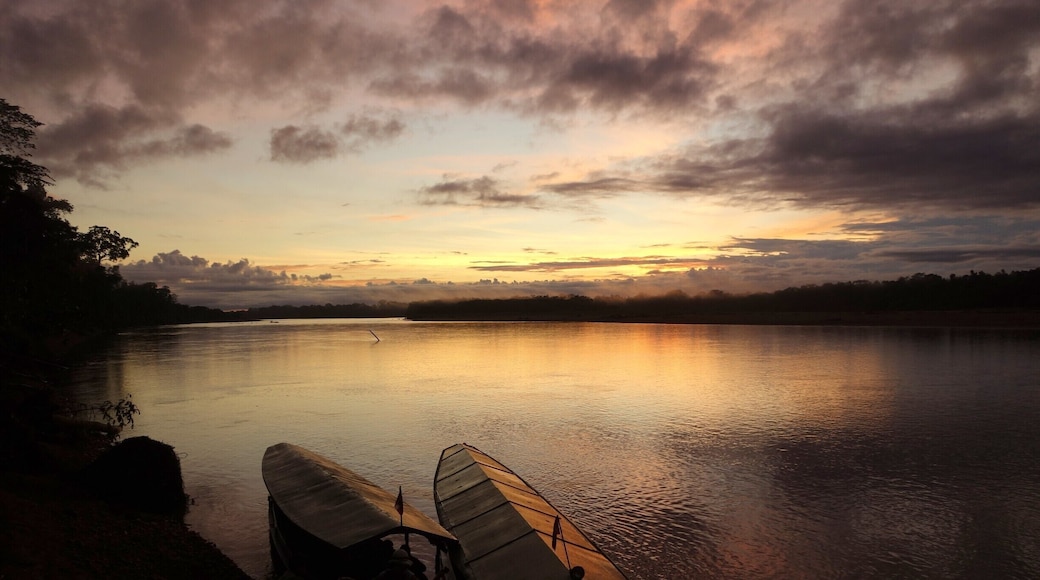
Sunrise at the Tambopata Research Center in the Peruvian Amazon rainforest. Cannot wait to be back there! #tambopata #peru #rainforest #travel #sunrise #rivers #river #welovetoexplore
Blue & Yellow Macaws in the Peruvian rainforest near the Tambopata Research Center. It blows my mind how many parrots we saw, and the variety of species. #mateforlife #macaws #rainforest #peru #tambopata #nature #parrots #birds #welovetoexplore
See those tiny little 'bumps' on this submerged log? It's a colony of adorable little Proboscis bats (Rhynchonycteris naso) that we found while canoeing on a remote oxbow lake in the rainforest of Peru! They sway like leaves in the wind to confuse predators, and were amazing little creatures to interact with! Proboscis bats live in groups. The colonies are usually between five and ten individuals, and very rarely exceed forty. The bats are nocturnal, sleeping during the day in an unusual formation: they lay one after another on a branch or wooden beam, nose to tail, in a straight row. A colony of proboscis bats usually has a regular feeding area, typically a small patch of water. Here the bats catch insects using echolocation. They have no specific breeding season, forming stable year-round harems. One young is born. Both sexes disperse after weaning at around 2–4 months. This is a small bat, around 6 centimetres (2.4 inches) long and 4 grams (0.0088 pounds) in weight. The species is characterized by its long, fleshy, and pointed nose. Its fur is soft and dense and is brownish-grey in color, with two white stripes down the back. Whether these stripes serve a purpose, such as camouflage or attraction of mates, is unknown. This bat also has gray tufts of fur on the forearms. No matter what time of day these features may make the bat difficult to see. #bata #tambopata #peru #rainforest #welovetoexplore
25
See all 25 photos
Check-in
Check-out
Guests
Search
Popular cities in Madre de Dios Region
Tambopata
Known for Jungles, Rain forests and Adventure
Explore city
Find hotels
Manu
Known for Natural parks
Explore city
Find hotels
Las Piedras
Explore city
Find hotels
Inambari
Explore city
Find hotels
Go further with the Expedia app
Save on select hotels and earn double points when you book on the app. Our app deals help you to save on trips so you can travel more and manage it all on the go.
Scan the QR code with your device camera and download our app
910f4660-c323-40a4-aa59-a1c1ffbadd64
f3de75ae-4cf8-4e31-a2fb-bd87e9d87010